

Here’s an opinion piece from yours truly, published in The Hindu in Delhi on US-China relations and managed strategic competition versus unmanaged strategic competition.
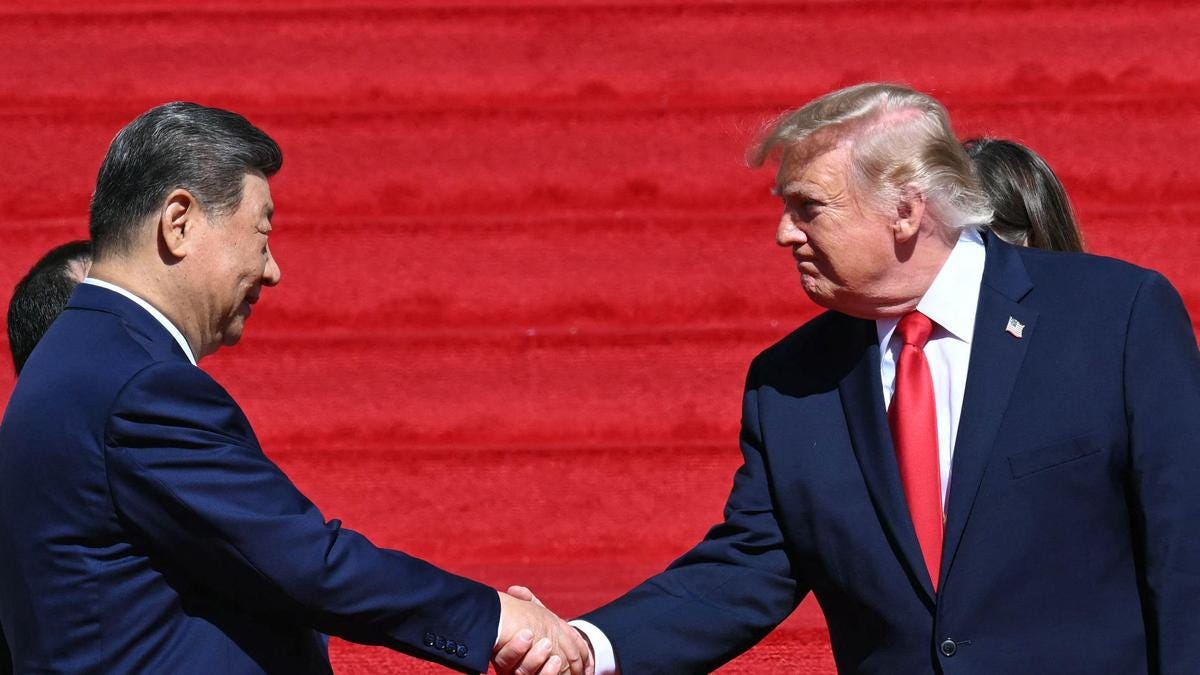
The world, understandably, has been watching carefully the unfolding summitry between the United States and Chinese Presidents over the last several months. It had been a long time between drinks: just under a decade in the case of President Donald Trump’s last visit to Beijing in late 2017; and just over a decade since President Xi Jinping stood on the White House lawns in 2015 with President Barack Obama.
Whereas now it is four summits in little more than six months: Beijing, Washington, Shenzhen and then Miami. Now it is everything, everywhere, all at once, with some speculating that we are seeing the birth of a new G-2.
It is natural for the world to wonder what, if anything, has fundamentally changed in the strategic architecture of the U.S.-China relationship. It is always hard to parse the difference between the language and theatre of politics and diplomacy, and what is actually happening on the ground.
Trump asked China’s president Xi if he wanted to buy U.S. arms while defending Taiwan sale, says envoy
Despite the pomp and circumstance in both the Beijing and Washington summits, the reality is that nothing much has changed in the fundamentals of the relationship. Whatever public language might be used, the U.S. and China remain fully engaged in an all-pervasive strategic competition on which of them will emerge as the dominant Indo-Pacific and then global power for the 21st century — militarily, in the economy, technology, foreign policy as well as the underlying ideological contest between democratic capitalism and China’s alternative authoritarian model.
Whatever the diplomatic surround sound might be, core decision-makers in both Washington and Beijing continue to have a deeply realist view of this ongoing strategic contest — or what the Chinese Communist Party (CCP)has long called the “struggle for the future of the international order”. Strategic competition is not going away. The real question is whether that competition can be managed within the framework of some mutually acceptable rules of the road. Or whether it is left unmanaged with a rolling risk of crisis, conflict or even war.
What the U.S. and China appear to be doing is moving towards an imperfect form of bilateral management mechanism. This process began in May last year with the regularisation of the political channel between U.S. Treasury Secretary Scott Bessent and Chinese Vice Premier He Lifeng. This followed the imposition of trade-destroying tariffs of 125% in April 2025 by Mr. Trump, which were then promptly matched by 125% from Mr. Xi. To preserve their respective national economic interests, both sides then walked back from the brink of a full trade war. Since then, Mr. Bessent, Mr. He and their teams have now met eight times — on average every two months. And after a tumultuous decade across every dimension of the relationship, the Bessent-He channel has indeed had a stabilising effect.
Beijing’s push for stability
China in particular has sought stability as it moves into 2027. Later next year, the CCP convenes the 21st Party Congress when Mr. Xi will be appointed to a record fourth term as General Secretary and where he hopes to appoint a fresh phalanx of personal loyalists to the party’s most senior positions. While Mr. Xi’s authority remains unchallenged, he will want as benign a domestic economic environment as possible.
China’s dilemma is that the domestic drivers of economic growth are performing poorly. Private domestic consumption is in the doldrums. Private residential construction is into its sixth year of recession. Private fixed capital investment is also flat-lining. That leaves public investment (i.e., China’s gargantuan techno-industrial strategy) and net exports as the two primary pistons driving the Chinese growth engine.
The last thing Beijing wants is for the U.S. to resume a full-scale trade war which Mr. Trump is perfectly capable of doing. Just look at what he did in 2018 and in 2025. China therefore has been doubling down on its “stability narrative” with the U.S. Its new concept of “constructive strategic stability” is about maximising “cooperation”, managing “competition within defined bounds”, while also managing “strategic differences”, which is code language for Taiwan. In China’s conceptual universe, if these three pillars are properly attended to, then the cardinal objective is achieved: stability.
It is an elegant schemata. It is China’s effort at “managed strategic competition” with the U.S. Moreover, the U.S. has formally accepted this framework in official readouts from the Beijing Washington Summits. But the U.S. has added the explicit caveat that any such bilateral framework be both “fair and reciprocal”.
For Washington realists, that is enough to drive a bus through any “constructive strategic stability” narrative on any day of the week. Furthermore, Beijing would be wildly optimistic if it concluded that Donald Trump is likely to be constrained in his future freedom of manoeuvre because of some grand, overarching foreign policy narrative. The President just does not operate that way.
A fragile truce
What concerns China most is if what is called the “Busan Tariff Truce” agreed to last October falls apart. That original 12-month truce has only been extended two months. If the U.S. concludes that China has not been helpful on U.S. agricultural exports, or in the normalisation of the critical minerals and rare earths trade with the U.S., there is a real risk that the Busan Truce collapses. And if the European Union were to move in the same direction on tariffs given the crisis in European manufacturing, the consequences for an export-dependent Chinese economy would be large.
For all these reasons, both tactical and strategic, the U.S.-China relationship remains deeply fragile. Even if the Busan Truce extends beyond December, the effective general U.S. tariff rate against China will remain much, much higher than, for example, India’s. Beyond trade, there also remains a formidable array of export controls on critical technologies, including world-class chips where China remains several years behind the U.S. And that leaves to one side a bilateral foreign investment regime which remains deeply restrictive at both ends of the relationship.
Therefore, breathless reporting about an emerging “G2” between the U.S. and China in some sort of global strategic condominium is fanciful. Whatever tactical accommodations may occur in the trade relationship, the fundamental nature of the strategic competition between Washington and Beijing continues. Remember it was Donald Trump, on the very eve of Mr. Xi’s state visit to Washington DC, who stated, “Whoever wins in AI, wins.” That is Xi Jinping’s view too. That does not exactly sound like an emerging G-2 to me.
East is East and West is West and never the twain shal meet!
But they can remain good friends.
For a little while longer, until the question of Taiwan comes up.
Then it'll be interesting to see what Americas reaction will be.
If the Reaction is Kneejerk, and Over the Top, as we usually expect from Americ, it'll cause problems.
But if it is restrained and taken logically and sensibly, then we can relax a little.
Here's the line in this article that concerns me..."The real question is whether that competition can be managed within the framework of some mutually acceptable rules of the road. Or whether it is left unmanaged with a rolling risk of crisis, conflict or even war." For now @kevin rudd I take some comfort that there is stability.
However, one factor that I'd put to you is what will happen in just over two years when another US President (at this stage clearly unknown and unknowable) becomes the President (technically January 2029). What do you think the Chinese are thinking and preparing for this certainty. How are they planning to read the 'wind' on that eventuality. You mention two Presidents Clinton and Obama in the article. Were not the Chinese arch realists when Nixon came to China? What would be the rules of those encounters into the future. Power politics and a realism of interests? A weighing up of power?
Look forward to your next posts. I am based in Melbourne and even though your articles 'drop' at 2 or 3 in the morning they seem to wake me up! Keep writing. I want to know how the whole story will end!